01 / Morfologi

Ciri dan struktur

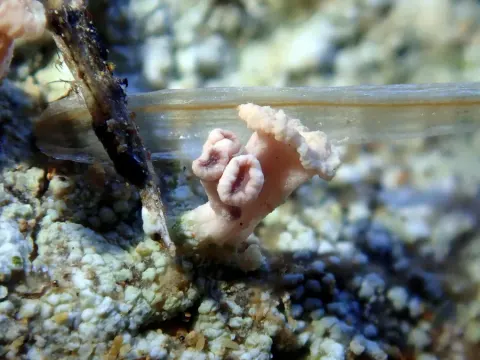
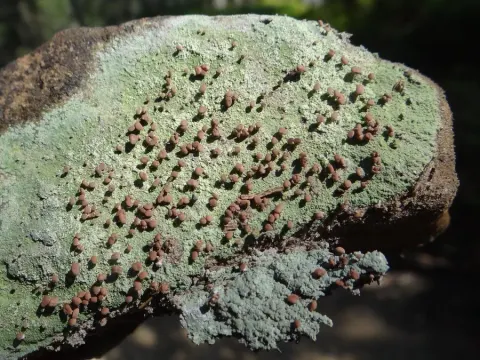
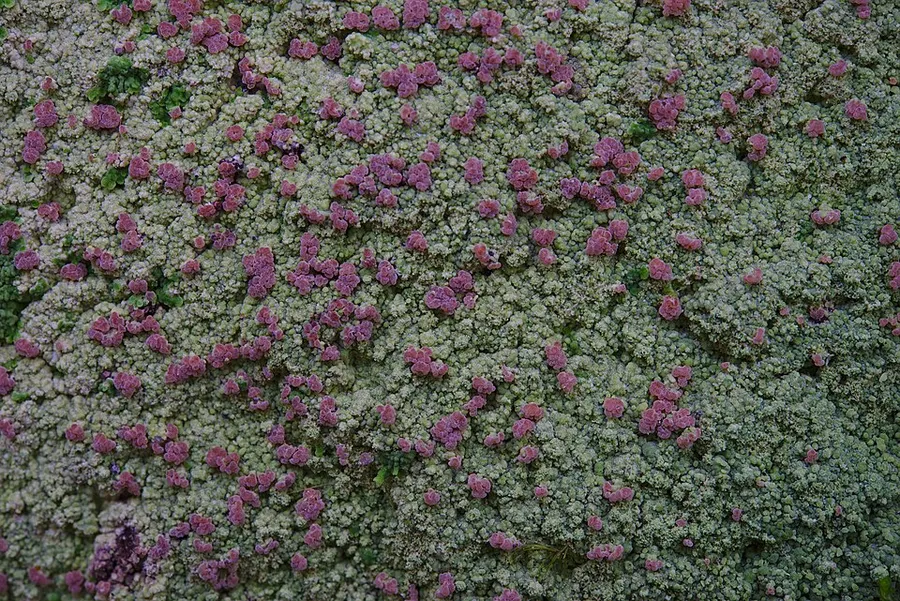
Baeomyces carneus spreads as a crust that can cover patches of soil, rotting wood or sheltered rock up to about 10 cm across. The surface ranges from coarse powder-like to closely packed, scale-like ; around the edge these scales may radiate outward to give a faint, rosette () outline. Colour is typically very pale green or light brown. Powdery soralia are scattered and sometimes absent, but minute, detachable flakes called —up to 0.3 mm wide and perfectly round—are usually abundant and serve as the main vegetative propagules. The algal partner consists of or slightly ellipsoid cells (6–14 μm in diameter) arranged in a continuous layer beneath the surface. Sexual fruit bodies are rare in British material yet common elsewhere. When present they form pinkish-brown up to 2 mm wide that may sit directly on the crust or rise on a solid stalk (stipe) 0.5–4 mm tall, itself occasionally branched and dusted with tiny squamules. Internally, the spore-bearing layer (hymenium) is 65–110 μm thick and threaded by slender filaments (paraphyses) whose tips swell only slightly to about 2.5 μm. Each cylindrical ascus (60–90 × 8–10 μm) releases eight colourless, spindle-shaped ascospores measuring roughly 8.5–12 × 2.5–4.5 μm. Chemical spot tests aid field identification: the thallus is negative with bleach (C−) but turns yellow then red with potassium hydroxide (K+ yellow → red), gives a red flash with the combined KC test, and reacts orange with paraphenylenediamine (Pd+). It shows no fluorescence under long-wave ultraviolet light (UV−). These reactions reflect abundant norstictic and connorstictic acids within the crust, while gyrophoric and lecanoric acids appear later and are restricted to mature apothecia.

Sebagian uraian ditampilkan dalam bahasa sumber; terjemahannya belum tersedia atau belum lolos pemeriksaan.

Rujukan: [1]

Pengukuran mengikuti objek, spesimen atau kultur, dan metode yang disebutkan sumber. Baca uraian asli untuk konteks lengkap.

02 / Kehidupan

Habitat dan peran ekologis

It is widely distributed in the boreal forest region of North America, and also occurs in Europe, New Zealand, the West Indies, and Hawaii.

Sebagian uraian ditampilkan dalam bahasa sumber; terjemahannya belum tersedia atau belum lolos pemeriksaan.

Rujukan: [1]

Habitat atau konteks temuan
hutan
Substrat
Informasi belum tersedia pada sumber rilis ini.
Peran atau konteks
Pembentuk liken
Temukan hubungan serupa
03 / Siklus hidup

Reproduksi

Sexual fruit bodies are rare in British material yet common elsewhere. When present they form pinkish-brown up to 2 mm wide that may sit directly on the crust or rise on a solid stalk (stipe) 0.5–4 mm tall, itself occasionally branched and dusted with tiny squamules. Internally, the spore-bearing layer (hymenium) is 65–110 μm thick and threaded by slender filaments (paraphyses) whose tips swell only slightly to about 2.5 μm. Each cylindrical ascus (60–90 × 8–10 μm) releases eight colourless, spindle-shaped ascospores measuring roughly 8.5–12 × 2.5–4.5 μm.

Sebagian uraian ditampilkan dalam bahasa sumber; terjemahannya belum tersedia atau belum lolos pemeriksaan.

Rujukan: [1]

Sinonim menurut acuan taksonomi rilis: Baeomyces byssoides var. carneus; Baeomyces rufus var. carneus; Biatora byssoides f. carnea; Biatora byssoides var. carnea; Lichen ericetorum var. carneus; Patellaria carnea; Sphyridium byssoides f. carneum; Sphyridium carneum; Sphyridium fungiforme var. carneum
04 / Batas informasi

Catatan identitas dan cakupan

  • Nama diterima mengikuti Catalogue of Life Base2026-09-11; uraian mempertahankan konsep dan nama sumber aslinya.
  • Original geographic, specimen and life-cycle scope retained; source import awaits individual editorial review.
  • Impor dan terjemahan otomatis belum diperiksa editorial per profil. Struktur reproduktif yang disebutkan tidak membuktikan seluruh siklus hidup diketahui.
  • Pengukuran pada uraian mengikuti spesimen, kultur, dan metode sumber; angka tidak diperluas ke semua populasi.

Catatan distribusi dalam narasi mengikuti sumbernya. Dokumentasi spesimen atau foto mengikuti catatan sumber. Bukti wilayah Indonesia dan penilaian konservasi tidak disimpulkan dari gambar.

05 / Dokumentasi

Melihat dengan konteks

Dokumentasi Baeomyces carneus dari Wikimedia Commons. 500px provided description: About the specimen: kpabg.ru/isl/?q=node/16726 [#macro ,#lichen ,#lichens] Identifikasi mengikuti record berkas sumber.

Jenis
Fotografi
Kredit
Alexey Melechin
Sumber media
Buka entri sumber

Gambar menunjukkan objek menurut identifikasi sumber, bukan verifikasi independen spesimen oleh Fungi. Tidak ada skala baru yang ditambahkan.

06 / Rujukan

Sumber profil

  1. [1] Baeomyces carneus — Wikipedia (en)Bagian sumber: Frozen revision 1331220644
    Tanggal penghimpunan sumber: 2026-10-12
    Teks sumber: CC BY-SA4.0 · Wikipedia contributors
  2. [2] Catalogue of Life Base2026-09-11 — Baeomyces carneusBagian sumber: ColDP NameUsage.tsv ID 68BPN; accepted species; source 2073
    Tanggal penghimpunan sumber: 2026-10-12
  3. [3] Dokumentasi visual — Baeomyces carneusBagian sumber: Individual media record; identification follows the source, not independent determination
    Tanggal penghimpunan sumber: 2026-10-12
    Media sumber: CC BY-SA 3.0 · Alexey Melechin

Adaptasi teks: CC BY-SA 4.0. Wikipedia contributors — Baeomyces carneus — Wikipedia (en)

Uraian asli dan riwayat sumber

Riwayat atau halaman sumber

Ringkasan sumber

Baeomyces carneus is a species of terricolous and saxicolous (ground- and rock-dwelling), squamulose lichen in the family Baeomycetaceae. This pale green to light brown lichen forms crusty patches on soil, rotting wood, or sheltered rocks, and spreads mainly through tiny detachable flakes rather than spores. It has a wide distribution across the boreal forests of North America and also occurs in Europe, New Zealand, Hawaii, and the West Indies.

Revisi sumber

Morfologi sumber

Baeomyces carneus spreads as a crust that can cover patches of soil, rotting wood or sheltered rock up to about 10 cm across. The surface ranges from coarse powder-like to closely packed, scale-like ; around the edge these scales may radiate outward to give a faint, rosette () outline. Colour is typically very pale green or light brown. Powdery soralia are scattered and sometimes absent, but minute, detachable flakes called —up to 0.3 mm wide and perfectly round—are usually abundant and serve as the main vegetative propagules. The algal partner consists of or slightly ellipsoid cells (6–14 μm in diameter) arranged in a continuous layer beneath the surface. Sexual fruit bodies are rare in British material yet common elsewhere. When present they form pinkish-brown up to 2 mm wide that may sit directly on the crust or rise on a solid stalk (stipe) 0.5–4 mm tall, itself occasionally branched and dusted with tiny squamules. Internally, the spore-bearing layer (hymenium) is 65–110 μm thick and threaded by slender filaments (paraphyses) whose tips swell only slightly to about 2.5 μm. Each cylindrical ascus (60–90 × 8–10 μm) releases eight colourless, spindle-shaped ascospores measuring roughly 8.5–12 × 2.5–4.5 μm. Chemical spot tests aid field identification: the thallus is negative with bleach (C−) but turns yellow then red with potassium hydroxide (K+ yellow → red), gives a red flash with the combined KC test, and reacts orange with paraphenylenediamine (Pd+). It shows no fluorescence under long-wave ultraviolet light (UV−). These reactions reflect abundant norstictic and connorstictic acids within the crust, while gyrophoric and lecanoric acids appear later and are restricted to mature apothecia.

Revisi sumber

Ekologi sumber

It is widely distributed in the boreal forest region of North America, and also occurs in Europe, New Zealand, the West Indies, and Hawaii.

Revisi sumber

Struktur reproduksi sumber

Sexual fruit bodies are rare in British material yet common elsewhere. When present they form pinkish-brown up to 2 mm wide that may sit directly on the crust or rise on a solid stalk (stipe) 0.5–4 mm tall, itself occasionally branched and dusted with tiny squamules. Internally, the spore-bearing layer (hymenium) is 65–110 μm thick and threaded by slender filaments (paraphyses) whose tips swell only slightly to about 2.5 μm. Each cylindrical ascus (60–90 × 8–10 μm) releases eight colourless, spindle-shaped ascospores measuring roughly 8.5–12 × 2.5–4.5 μm.

Revisi sumber

Rujukan halaman ini

Fungi. Baeomyces carneus. Rilis data fungi-2026-10-12-expansion-2. https://fungi-atlas.mgadib.chatgpt.site/jamur/baeomyces-carneus/.

Status: impor sumber; pemeriksaan editorial per profil belum selesai. Untuk klaim biologis, gunakan rujukan pada bagian terkait dan periksa konteks sumber aslinya.