01 / Morfologi

Ciri dan struktur

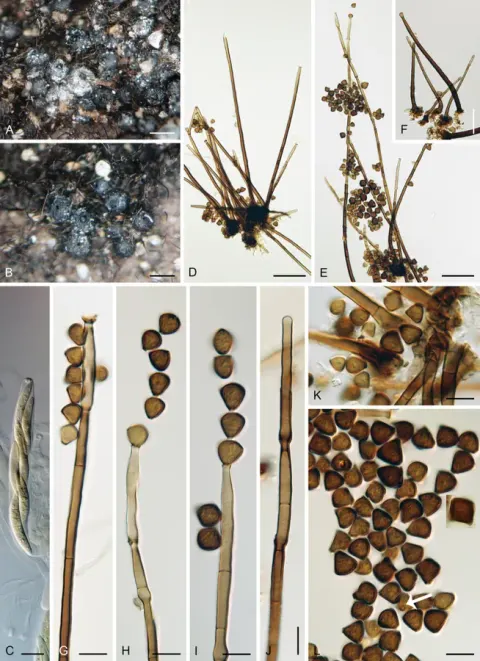
Colonies on natural substrate effuse, hairy to velutinous, dark brown to almost black. Anamorph. Conidiophores 77–220 × 4.5–6(–7) μm wide, 7–8 μm above the base, macronematous, solitary or arise in tufts, erect, straight or slightly flexuous, unbranched, dark brown, paler towards the apex, septate. Capitate hyphae absent. Conidiogenous cells 18–25 × 3.5–4.5 μm tapering to ca. 2.5 μm, integrated, terminal, monophialidic, extending percurrently, obclavate to subcylindrical or slightly lageniform, pale brown, paler towards the apex; collarettes 3–4 μm wide, 1.5(–2) μm deep, funnel-shaped, subhyaline, smooth, margin entire. Conidia 6–8(–9) μm long, 4.5–6(–7) μm wide at the apical end, ca. 2 μm wide at the basal hilum (mean ± SD = 7.4 ± 1.1 × 6.0 ± 1.2 μm × 2.0 ± 0.0 μm), rounded-obconic in side view, with three blunt corners when viewed from above, broadly rounded to flattened at the apex, truncate at the basal scar, pale brown to pale fuscous, thick-walled, smooth; formed singly, adhered in basipetal chains. Teleomorph. Unknown.

Sebagian uraian ditampilkan dalam bahasa sumber; terjemahannya belum tersedia atau belum lolos pemeriksaan.

Rujukan: [1]

Pengukuran mengikuti objek, spesimen atau kultur, dan metode yang disebutkan sumber. Baca uraian asli untuk konteks lengkap.

02 / Kehidupan

Habitat dan peran ekologis

Saprobe on dead culms of Bambusa sp., decaying wood of Fagus sp. and other unknown hosts in freshwater and terrestrial habitats. It is known in China, India and the USA (Linder 1933; Sharma 1980; Luo et al. 2019 as C. cubensis).

Sebagian uraian ditampilkan dalam bahasa sumber; terjemahannya belum tersedia atau belum lolos pemeriksaan.

Rujukan: [1]

Habitat atau konteks temuan
Informasi belum tersedia pada sumber rilis ini.
Substrat
Informasi belum tersedia pada sumber rilis ini.
Peran atau konteks
Belum dikategorikan pada rilis ini.
Temukan hubungan serupa
03 / Siklus hidup

Reproduksi

Colonies on natural substrate effuse, hairy to velutinous, dark brown to almost black. Anamorph. Conidiophores 77–220 × 4.5–6(–7) μm wide, 7–8 μm above the base, macronematous, solitary or arise in tufts, erect, straight or slightly flexuous, unbranched, dark brown, paler towards the apex, septate. Capitate hyphae absent. Conidiogenous cells 18–25 × 3.5–4.5 μm tapering to ca. 2.5 μm, integrated, terminal, monophialidic, extending percurrently, obclavate to subcylindrical or slightly lageniform, pale brown, paler towards the apex; collarettes 3–4 μm wide, 1.5(–2) μm deep, funnel-shaped, subhyaline, smooth, margin entire. Conidia 6–8(–9) μm long, 4.5–6(–7) μm wide at the apical end, ca. 2 μm wide at the basal hilum (mean ± SD = 7.4 ± 1.1 × 6.0 ± 1.2 μm × 2.0 ± 0.0 μm), rounded-obconic in side view, with three blunt corners when viewed from above, broadly rounded to flattened at the apex, truncate at the basal scar, pale brown to pale fuscous, thick-walled, smooth; formed singly, adhered in basipetal chains.

Sebagian uraian ditampilkan dalam bahasa sumber; terjemahannya belum tersedia atau belum lolos pemeriksaan.

Rujukan: [1]

Sinonim menurut acuan taksonomi rilis: Haplochalara angulospora
04 / Batas informasi

Catatan identitas dan cakupan

  • Nama diterima mengikuti Catalogue of Life Base2026-09-11; uraian mempertahankan konsep dan nama sumber aslinya.
  • Preserve original treatment localities, hosts and substrate scope. Materials examined describe documented specimens, not the full global range.
  • Impor dan terjemahan otomatis belum diperiksa editorial per profil. Struktur reproduktif yang disebutkan tidak membuktikan seluruh siklus hidup diketahui.
  • Pengukuran pada uraian mengikuti spesimen, kultur, dan metode sumber; angka tidak diperluas ke semua populasi.

Catatan distribusi dalam narasi mengikuti sumbernya. Dokumentasi spesimen atau foto mengikuti catatan sumber. Bukti wilayah Indonesia dan penilaian konservasi tidak disimpulkan dari gambar.

05 / Dokumentasi

Melihat dengan konteks

Catenularia angulospora (holotype FH 00965375) A vertical section of the wood with colony B–D conidiophores with conidia. Scale bars: 500 μm (A); 50 μm (B–D).

Jenis
Pelat ilmiah
Kredit
Martina Réblová, Jana Nekvindová, Andrew N. Miller
Lisensi
CC BY 4.0
Sumber media
Buka entri sumber

Gambar menunjukkan objek menurut identifikasi sumber, bukan verifikasi independen spesimen oleh Fungi. Tidak ada skala baru yang ditambahkan.

06 / Rujukan

Sumber profil

  1. [1] Phylogeny and taxonomy of Catenularia and similar fungi with catenate conidia — Catenularia angulosporaBagian sumber: PMC8213683_section_13
    Tanggal penghimpunan sumber: 2026-10-12
    Teks sumber: CC BY 4.0 · Réblová M, Nekvindová J, Miller AN.
  2. [2] Catalogue of Life Base2026-09-11 — Catenularia angulosporaBagian sumber: ColDP NameUsage.tsv ID 69FP8; accepted species; source 2073
    Tanggal penghimpunan sumber: 2026-10-12
  3. [3] Dokumentasi visual — Catenularia angulosporaBagian sumber: Individual media record; identification follows the source, not independent determination
    Tanggal penghimpunan sumber: 2026-10-12
    Media sumber: CC BY 4.0 · Martina Réblová, Jana Nekvindová, Andrew N. Miller

Adaptasi teks: CC BY 4.0. Réblová M, Nekvindová J, Miller AN. — Phylogeny and taxonomy of Catenularia and similar fungi with catenate conidia — Catenularia angulospora

Uraian asli dan riwayat sumber

Riwayat atau halaman sumber

Ringkasan sumber

Colonies on natural substrate effuse, hairy to velutinous, dark brown to almost black. Anamorph. Conidiophores 77–220 × 4.5–6(–7) μm wide, 7–8 μm above the base, macronematous, solitary or arise in tufts, erect, straight or slightly flexuous, unbranched, dark brown, paler towards the apex, septate. Capitate hyphae absent. Conidiogenous cells 18–25 × 3.5–4.5 μm tapering to ca. 2.5 μm, integrated, terminal, monophialidic, extending percurrently, obclavate to subcylindrical or slightly lageniform, pale brown, paler towards the apex; collarettes 3–4 μm wide, 1.5(–2) μm deep, funnel-shaped, subhyaline, smooth, margin entire.

Revisi sumber

Morfologi sumber

Colonies on natural substrate effuse, hairy to velutinous, dark brown to almost black. Anamorph. Conidiophores 77–220 × 4.5–6(–7) μm wide, 7–8 μm above the base, macronematous, solitary or arise in tufts, erect, straight or slightly flexuous, unbranched, dark brown, paler towards the apex, septate. Capitate hyphae absent. Conidiogenous cells 18–25 × 3.5–4.5 μm tapering to ca. 2.5 μm, integrated, terminal, monophialidic, extending percurrently, obclavate to subcylindrical or slightly lageniform, pale brown, paler towards the apex; collarettes 3–4 μm wide, 1.5(–2) μm deep, funnel-shaped, subhyaline, smooth, margin entire. Conidia 6–8(–9) μm long, 4.5–6(–7) μm wide at the apical end, ca. 2 μm wide at the basal hilum (mean ± SD = 7.4 ± 1.1 × 6.0 ± 1.2 μm × 2.0 ± 0.0 μm), rounded-obconic in side view, with three blunt corners when viewed from above, broadly rounded to flattened at the apex, truncate at the basal scar, pale brown to pale fuscous, thick-walled, smooth; formed singly, adhered in basipetal chains. Teleomorph. Unknown.

Revisi sumber

Ekologi sumber

Saprobe on dead culms of Bambusa sp., decaying wood of Fagus sp. and other unknown hosts in freshwater and terrestrial habitats. It is known in China, India and the USA (Linder 1933; Sharma 1980; Luo et al. 2019 as C. cubensis).

Revisi sumber

Struktur reproduksi sumber

Colonies on natural substrate effuse, hairy to velutinous, dark brown to almost black. Anamorph. Conidiophores 77–220 × 4.5–6(–7) μm wide, 7–8 μm above the base, macronematous, solitary or arise in tufts, erect, straight or slightly flexuous, unbranched, dark brown, paler towards the apex, septate. Capitate hyphae absent. Conidiogenous cells 18–25 × 3.5–4.5 μm tapering to ca. 2.5 μm, integrated, terminal, monophialidic, extending percurrently, obclavate to subcylindrical or slightly lageniform, pale brown, paler towards the apex; collarettes 3–4 μm wide, 1.5(–2) μm deep, funnel-shaped, subhyaline, smooth, margin entire. Conidia 6–8(–9) μm long, 4.5–6(–7) μm wide at the apical end, ca. 2 μm wide at the basal hilum (mean ± SD = 7.4 ± 1.1 × 6.0 ± 1.2 μm × 2.0 ± 0.0 μm), rounded-obconic in side view, with three blunt corners when viewed from above, broadly rounded to flattened at the apex, truncate at the basal scar, pale brown to pale fuscous, thick-walled, smooth; formed singly, adhered in basipetal chains.

Revisi sumber

Rujukan halaman ini

Fungi. Catenularia angulospora. Rilis data fungi-2026-10-12-expansion-2. https://fungi-atlas.mgadib.chatgpt.site/jamur/catenularia-angulospora/.

Status: impor sumber; pemeriksaan editorial per profil belum selesai. Untuk klaim biologis, gunakan rujukan pada bagian terkait dan periksa konteks sumber aslinya.