Ciri dan struktur
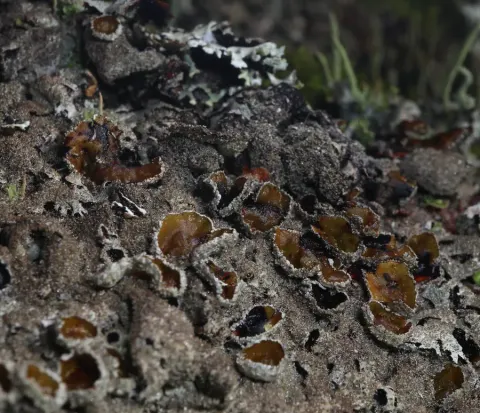
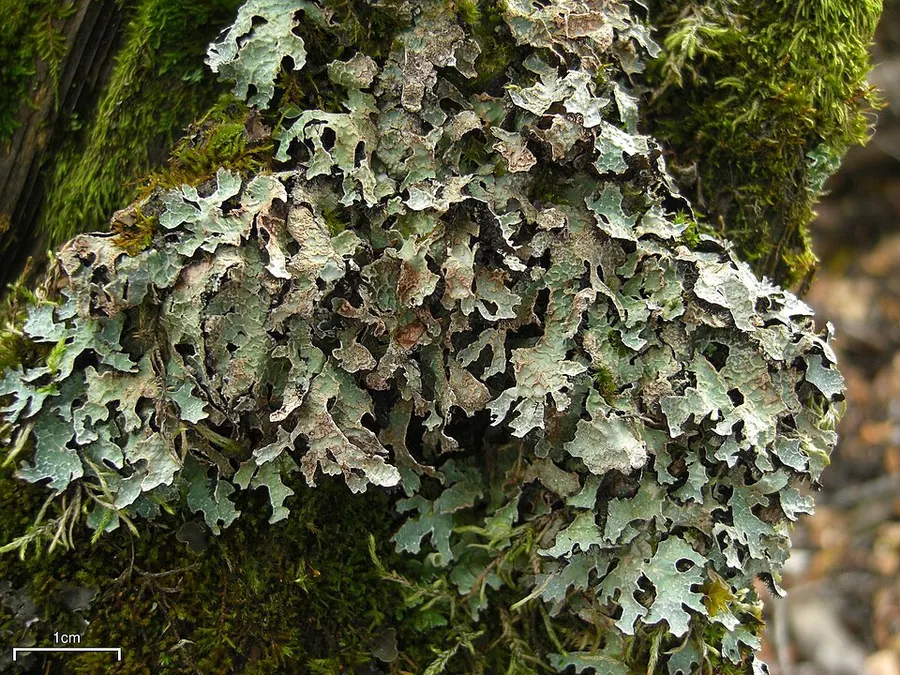
Parmelia barrenoae has a foliose (leafy) thallus with a tight to loose attachment to its substrate. It measures 5 – 10 cm in diameter. The lobes are contiguous to overlapping, with short, rounded tips, measuring 2–7 mm wide. The older lobes tend to curve backwards. The upper surface of the thallus is greenish grey to whitish grey, with a texture that is initially finely foveolate (covered with small pits) before becoming reticulate (net-like) and cracked. The thickness of the thallus is somewhat variable; depending on whether the central areas or the margins are measured, ranging from 200 to 375 μm. Of this, the cortex is 25–37.5 μm thick, the photobiont layer about 30–40 μm thick, the medulla 120–200 μm thick, and the underlying darkened cortex 25–40 μm thick. The latter tissue layer, which gives the thallus underside its blackened colour, is paraplectenchyma—a type of tissue in which the fungal hyphae are oriented in all directions. The photobiont layer of mature specimens is a continuous layer, while in younger specimens it is arranged in discrete aggregations of glomerules (clusters of photobiont cells). Pseudocyphellae are tiny pores in the cortex that allow for gas exchange through the lichen tissue; these formless holes are numerous in the thallus of Parmelia barrenoae, where they occur on both the thallus surface (i.e., laminal) and along its margins (i.e., marginal). The marginal pseudocyphellae are more or less evenly distributed, while the laminal pseudocyphellae are linear to irregularly shaped and occur mainly on ridges. These pseudocyphellae are separate in the centre but form a network near the periphery of the thallus.
Habitat dan peran ekologis
First described from Ávila, and a few years later from the Castellón mountains and Asturias, the geographical range of Parmelia barrenoae has increased expansively as other researchers have reported its occurrence in other locations. In 2010, the lichen was reported to occur in North America and Africa. The North American distribution includes the western United States, based on specimens collected in the states of California, Idaho, Oregon, and Washington. The African distribution includes the Middle Atlas mountain range of Morocco. In 2016, it was reported from Poland, in 2017 from Macedonia, and in 2018 from Turkey and Asia for the first time. In 2021 it was reported to occur in Hungary, Slovakia and Sweden. In some areas its precise range is not yet well known because of historical confusion with P. sulcata. In the Mediterranean, Parmelia barrenoae is widely distributed on oak bark and conifers. It is occasionally on moss-covered rocks in open and sunny places. The species occurs in Mediterranean areas at moderate altitudes between 800 – 1800 m. In this region it often co-occurs with Parmelia serrana and various species of Lobaria. In Hungary and Slovakia, the lichen was found in oak-hornbeam and oak forests at elevations between 260 and 500 m.
- Habitat atau konteks temuan
- hutan
- Substrat
- Informasi belum tersedia pada sumber rilis ini.
- Peran atau konteks
- Pembentuk liken
Reproduksi
Pseudocyphellae are tiny pores in the cortex that allow for gas exchange through the lichen tissue; these formless holes are numerous in the thallus of Parmelia barrenoae, where they occur on both the thallus surface (i.e., laminal) and along its margins (i.e., marginal). The marginal pseudocyphellae are more or less evenly distributed, while the laminal pseudocyphellae are linear to irregularly shaped and occur mainly on ridges. These pseudocyphellae are separate in the centre but form a network near the periphery of the thallus. Soralia (decorticated regions on the thallus surface where soredia are produced) are sparse, laminal, and develop from old cracked pseudocyphellae. They are linear to irregular in shape, and the soredia (microscopic groups of algal cells and loosely woven hyphae) are granular.
Catatan identitas dan cakupan
- Nama diterima mengikuti Catalogue of Life Base2026-09-11; uraian mempertahankan konsep dan nama sumber aslinya.
- Original geographic, specimen and life-cycle scope retained; source import awaits individual editorial review.
- Impor dan terjemahan otomatis belum diperiksa editorial per profil. Struktur reproduktif yang disebutkan tidak membuktikan seluruh siklus hidup diketahui.
- Pengukuran pada uraian mengikuti spesimen, kultur, dan metode sumber; angka tidak diperluas ke semua populasi.
Catatan distribusi dalam narasi mengikuti sumbernya. Dokumentasi spesimen atau foto mengikuti catatan sumber. Bukti wilayah Indonesia dan penilaian konservasi tidak disimpulkan dari gambar.
Melihat dengan konteks
Dokumentasi Parmelia barrenoae dari Wikimedia Commons. The foliose lichen Parmelia barrenoae Divakar, M.C. Molina & A. Crespo, photographed in Edgewood Blue, Wells Gray region, British Columbia, Canada. "Notes: growing on fallen mossy trunk in floodplain of Clearwater River, fairly moist dark habitat". Identifikasi mengikuti record berkas sumber.
- Jenis
- Fotografi
- Kredit
- Jason Hollinger
- Lisensi
- CC BY-SA 3.0
- Sumber media
- Buka entri sumber
Sumber profil
- [1] Parmelia barrenoae — Wikipedia (en)
- [2] Catalogue of Life Base2026-09-11 — Parmelia barrenoae
- [3] Dokumentasi visual — Parmelia barrenoae
Rujukan halaman ini
Fungi. Parmelia barrenoae. Rilis data fungi-2026-10-12-expansion-2. https://fungi-atlas.mgadib.chatgpt.site/jamur/parmelia-barrenoae/.
Status: impor sumber; pemeriksaan editorial per profil belum selesai. Untuk klaim biologis, gunakan rujukan pada bagian terkait dan periksa konteks sumber aslinya.