Ciri dan struktur
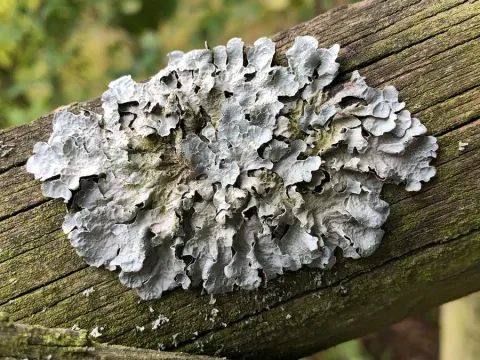
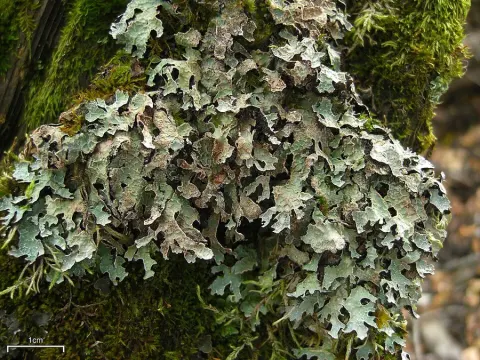
Parmelia serrana features a crustose, thallus that is closely adpressed to the and forms orbicular patches up to 15 cm in diameter. The thallus consists of overlapping () lobes, which are typically 2.5–6 mm wide, apically rounded to sublinear, and show a pale greenish grey to whitish grey colour. The surface is shiny and may become reticulately cracked as it ages. Pseudocyphellae (tiny pores for gas exchange) are numerous and mainly linear to irregularly shaped, scattered across the . Over time, the pseudocyphellae become , forming orbicular to linear soralia with eroded centres as they age. Isidia are densely packed on older parts of the thallus, cylindrical in shape, and to branched. The lower surface has sparse to moderately abundant, to sparsely branched rhizines, which measure 1–1.5 mm long. Apothecia (fruiting bodies) are fairly common, subpedicellate, with a that is initially concave, expanding to 1–4 mm in diameter. are broadly ellipsoid, measuring 17–18 by 12–13 μm. Chemical spot tests on the thallus reveal a that reacts K+ (yellow); the medulla shows a K+ (yellow then red) reaction, C−, PD+ (red-orange). Known chemical constituents include atranorin, chloroatranorin, salazinic acid, consalazinic acid, and trace amounts of protocetraric acid.
Habitat dan peran ekologis
Parmelia serrana grows on deciduous and coniferous trees, and less frequently on mossy rocks. It is particularly prevalent on Pinus sylvestris and various species of Quercus (oak). The species is widespread in the Sierra del Guadarrama and other mountain ranges within its native Mediterranean and submediterranean zones, from approximately 300 to 1700 metres in elevation. In terms of its geographic spread, Parmelia serrana is found in Africa (notably the Canary Islands) and across Europe. While it is prevalent in Mediterranean mountains, its full distribution in Europe remains partially understood, with occurrences noted at lower altitudes in more temperate, somewhat continental regions like Austria. The species is well-adapted to the Iberian Peninsula and the Canary Islands and is successful in colonising a range of habitats within these regions.
- Habitat atau konteks temuan
- Informasi belum tersedia pada sumber rilis ini.
- Substrat
- Informasi belum tersedia pada sumber rilis ini.
- Peran atau konteks
- Pembentuk liken
Reproduksi
Pseudocyphellae (tiny pores for gas exchange) are numerous and mainly linear to irregularly shaped, scattered across the . Over time, the pseudocyphellae become , forming orbicular to linear soralia with eroded centres as they age. Isidia are densely packed on older parts of the thallus, cylindrical in shape, and to branched. The lower surface has sparse to moderately abundant, to sparsely branched rhizines, which measure 1–1.5 mm long.
Catatan identitas dan cakupan
- Nama diterima mengikuti Catalogue of Life Base2026-09-11; uraian mempertahankan konsep dan nama sumber aslinya.
- Original geographic, specimen and life-cycle scope retained; source import awaits individual editorial review.
- Impor dan terjemahan otomatis belum diperiksa editorial per profil. Struktur reproduktif yang disebutkan tidak membuktikan seluruh siklus hidup diketahui.
- Pengukuran pada uraian mengikuti spesimen, kultur, dan metode sumber; angka tidak diperluas ke semua populasi.
Catatan distribusi dalam narasi mengikuti sumbernya. Dokumentasi spesimen atau foto mengikuti catatan sumber. Bukti wilayah Indonesia dan penilaian konservasi tidak disimpulkan dari gambar.
Melihat dengan konteks
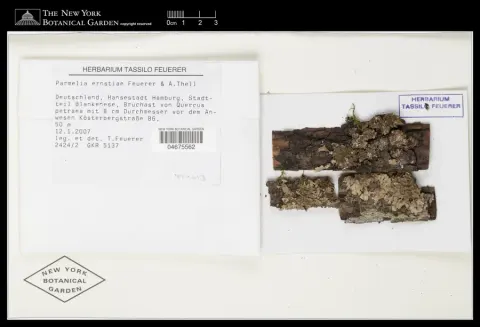
Dokumentasi Parmelia serrana dari Wikimedia Commons. Herbarium specimen of Parmelia serrana Identifikasi mengikuti record berkas sumber.
- Jenis
- Fotografi
- Kredit
- E. Pittao
- Lisensi
- CC BY-SA 4.0
- Sumber media
- Buka entri sumber
Sumber profil
- [1] Parmelia serrana — Wikipedia (en)
- [2] Catalogue of Life Base2026-09-11 — Parmelia serrana
- [3] Dokumentasi visual — Parmelia serrana
Rujukan halaman ini
Fungi. Parmelia serrana. Rilis data fungi-2026-10-12-expansion-2. https://fungi-atlas.mgadib.chatgpt.site/jamur/parmelia-serrana/.
Status: impor sumber; pemeriksaan editorial per profil belum selesai. Untuk klaim biologis, gunakan rujukan pada bagian terkait dan periksa konteks sumber aslinya.